Meter it.
Track compute, memory, storage, network and accelerated capacity as cloud resources.
Run the same open-source Triton platform behind Triton Cloud on infrastructure you control. Give teams projects, APIs and self-service resources while your operators retain control of the hardware.
Run Triton on your infrastructure with scope defined together.
Standard hardware · Multi-tenant · API-first · Open source
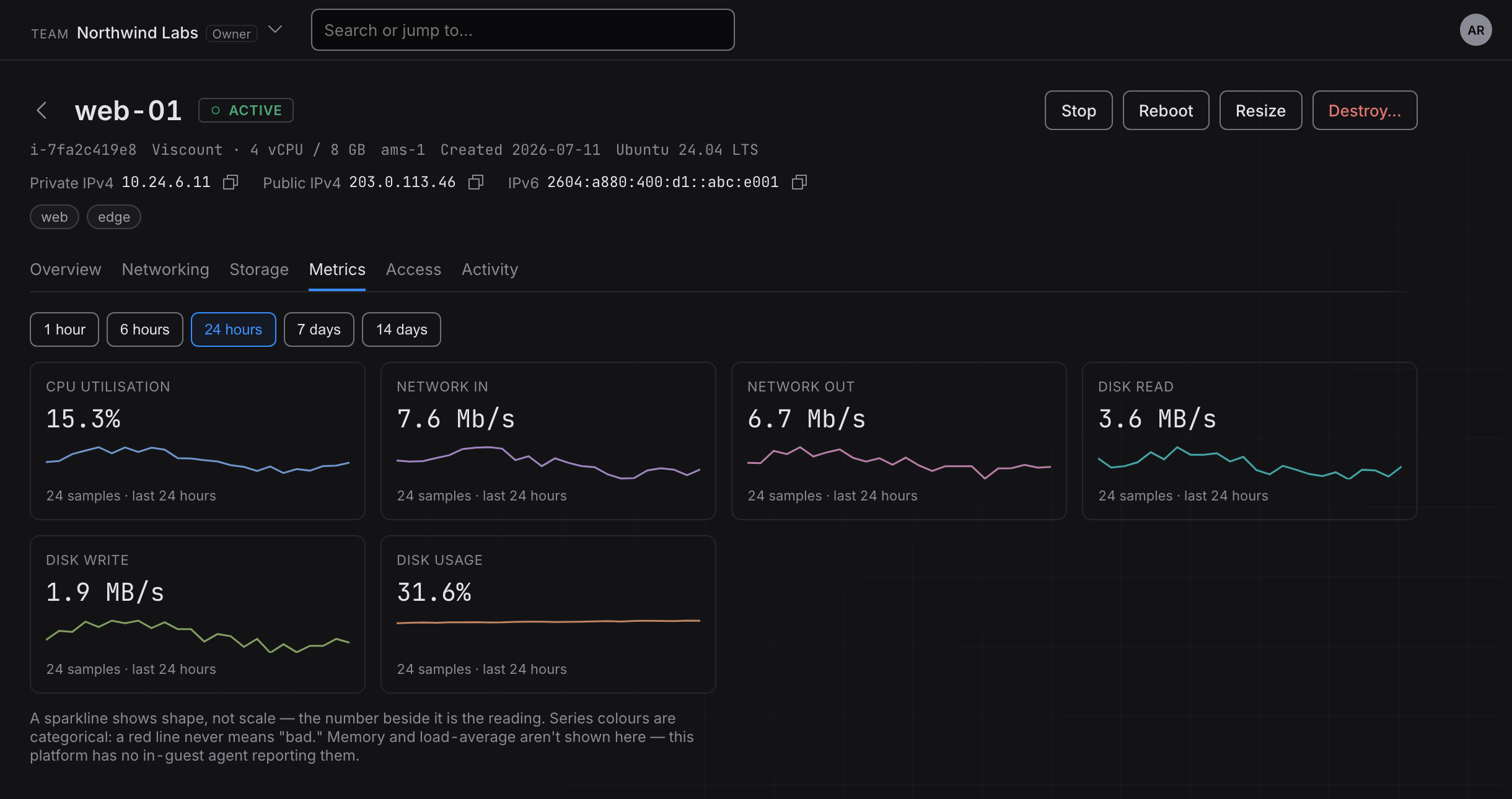
A running server, live, CPU, network and disk at a glance.
Triton began at Joyent as a platform for public and private cloud infrastructure.
Samsung acquired Joyent in 2016 to bring that cloud technology into its own global cloud strategy. Triton Cloud carries the operating experience forward into a new generation of the platform.
Scaled
Rebuilt
Sources: Samsung acquisition announcement · Samsung connected-cloud architecture
Broadcom has given many infrastructure teams a reason to reconsider VMware. A lower licensing bill may solve the immediate problem.
The bigger opportunity is to change how infrastructure is delivered.Map workloads, hardware and dependencies.
Run Triton on a defined slice of infrastructure.
Validate workloads, operations and automation.
Move more capacity where the platform and workload fit.
A VMware exit can be a hypervisor replacement—or the beginning of a real private cloud.
See if Triton fits your VMware environmentCloud changed the contract between infrastructure teams and application teams. Operators define capacity, policy and boundaries. Teams consume compute, storage and networking as resources—through a portal, CLI, API or automation.
That operating model should not disappear when the hardware is in your datacenter.Teams interact with the underlying domains.
Teams consume resources inside defined boundaries.
A hypervisor runs virtual machines. A cloud also needs identity, tenancy, networking, storage, APIs and a way for teams to consume those resources. Triton brings those layers into one operating model.
Virtualization stops here.
Triton continues.
Triton Cloud runs on the same open-source cloud platform available for your datacenter.
Use Triton as a public cloud operated by us, or deploy it on infrastructure you control. The operator changes. The platform doesn’t.Portal · CLI · API · Projects · Resources
Projects · APIs · Compute · Storage · Networking · Automation
Our infrastructure
Our operations
Public cloud
Your infrastructure
Your operations
Private or sovereign cloud
The software underneath Triton Cloud is available to inspect and run on infrastructure you control.
Use Triton Cloud.
Deploy Triton on your infrastructure.
The platform is open source.
Triton turns infrastructure you own into measurable cloud capacity. Track consumption by tenant, project, workload or service—and give teams the cost visibility they expect from public cloud.
Compute · Memory · Storage · Network · Accelerated capacity
Usage records · Resource rates · Capacity consumed
Tenant → Project → Workload
Track compute, memory, storage, network and accelerated capacity as cloud resources.
Connect consumption to the tenant, project, workload or team responsible for it.
Define internal rates for showback, chargeback, budgeting and capacity planning.
Your datacenter stops being one big infrastructure bill.
Running a cloud should not require a maze of operational tools. Triton gives infrastructure teams a clear model for health, capacity, lifecycle and policy while developers get the self-service experience they expect from cloud.
The complexity stays in the platform, not in the workflow.Built for Day 2. Provisioning is the start. Triton is designed around operating infrastructure after it enters production.
Ask for the resource. Not the infrastructure behind it.
Easy to operate. Easy to consume.
Triton divides shared infrastructure into explicit organizational and application boundaries. Operators control the physical cloud while tenants and teams work inside the capacity, policy and quotas assigned to them.
Instances · Networks · Storage
Compute · Accelerated capacity · Storage
Instances · Images · Networks
Compute · Networks · Storage
Instances · Images · Storage
Divide organizations, customers and workloads through explicit identity, resource and policy boundaries.
Give teams control inside their projects without giving them control of the infrastructure.
Track capacity and consumption from tenant down to project and workload.
Shared infrastructure. Clear ownership.
Triton is designed for workloads where ownership, locality, tenant isolation or sustained infrastructure matter.
Bring enterprise workloads into a cloud operating model without making application modernization the first requirement.
Enterprise apps · Databases · Internal platforms · Legacy workloadsTurn shared capacity into project-based resources that teams can consume directly.
Engineering teams · Platform groups · Shared servicesDivide shared infrastructure into tenants with clear boundaries for resources, policy and consumption.
Cloud providers · SaaS infrastructure · Business unitsBuild GPU-backed capacity for private inference, training and data-intensive workloads on infrastructure you control.
Private AI · Inference · Training · Data-intensive workloadsTell us what you’re running. We’ll show you how Triton could fit and what a practical deployment would look like.